![[personal profile]](https://www.dreamwidth.org/img/silk/identity/user.png)
1% prepper
Sep. 26th, 2026 11:14 amOccasionally I worry about the collapse of civilization and "how will I eat". Not enough to be a full-blown prepper, or to learn to shoot a bow and arrow to take down the many deer, geese, and turkeys that traipse through our yard, but apparently enough to learn how to eat acorns.
I did some research on the Internet (there's a lot of other people doing this), and yesterday I gathered some acorns. It's apparently a mast year where the trees drop a billion more acorns than usual, which makes raking more difficult, but it sure did make it easy to gather several pounds of acorns.
All the websites start with "dry your acorns" or "crack your acorns". But I started with "wash your acorns". The aforementioned wildlife poop all over our yard, and while I tried to gather my acorns from a place that was not obviously completely covered in deer poop, I'm sure there was some. There was also a lot of leaves and dirt mixed in with the acorns, even though I tried to brush the leaves away.
I started with a 5 gallon bucket which I filled with water, and stirred so that the leaves floated to the top. A bunch of acorns also floated to the top. I had read about this: there's a bug which lays its eggs in the flower, and then as the acorn develops around the egg, the larvae hatch and eat the ready-made food! Leaving the acorn empty shell and thus floating. The larvae actually drill their way out, so there is also a small hole. One of the websites said "it's kind of like Alien". It took a few washings and dumpings to get most of the floating stuff out. But that left dirt in the bottom, which was more difficult because it was a similar density. I ran it through a colander, but some of the dirt pieces were too large. So there was an annoying handpicking stage of separating the acorns from the dirt. Then I put them in soapy water and agitated thoroughly with my hands before rinsing.
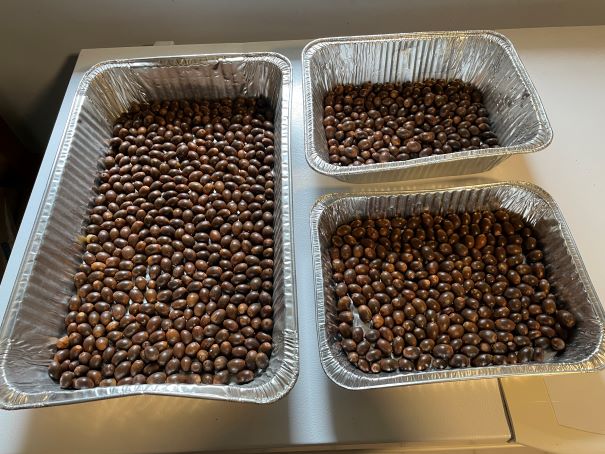
Now I have them in some trays, drying. The Internet is conflicted on how long I should dry them. Some people, who live in places like Arizona, just say "dry them in the sun". I live in New England, and it's late September, and there's not as much sun, and what there is, is not that warm. I would rather not put them in the oven, just for "native verisimilitude" (although I do plan to use a food processor in the end). So I think I will just leave them out for a few weeks and try cracking one periodically. I tried cracking one, and it was difficult to crack because the shell was springy, and even after cracking was hard to peel off. Then I tried a nibble, and it was pretty bitter. There's a whole process for that.
More blog posts to come in the future as this project advances!
I did some research on the Internet (there's a lot of other people doing this), and yesterday I gathered some acorns. It's apparently a mast year where the trees drop a billion more acorns than usual, which makes raking more difficult, but it sure did make it easy to gather several pounds of acorns.
All the websites start with "dry your acorns" or "crack your acorns". But I started with "wash your acorns". The aforementioned wildlife poop all over our yard, and while I tried to gather my acorns from a place that was not obviously completely covered in deer poop, I'm sure there was some. There was also a lot of leaves and dirt mixed in with the acorns, even though I tried to brush the leaves away.
I started with a 5 gallon bucket which I filled with water, and stirred so that the leaves floated to the top. A bunch of acorns also floated to the top. I had read about this: there's a bug which lays its eggs in the flower, and then as the acorn develops around the egg, the larvae hatch and eat the ready-made food! Leaving the acorn empty shell and thus floating. The larvae actually drill their way out, so there is also a small hole. One of the websites said "it's kind of like Alien". It took a few washings and dumpings to get most of the floating stuff out. But that left dirt in the bottom, which was more difficult because it was a similar density. I ran it through a colander, but some of the dirt pieces were too large. So there was an annoying handpicking stage of separating the acorns from the dirt. Then I put them in soapy water and agitated thoroughly with my hands before rinsing.
Now I have them in some trays, drying. The Internet is conflicted on how long I should dry them. Some people, who live in places like Arizona, just say "dry them in the sun". I live in New England, and it's late September, and there's not as much sun, and what there is, is not that warm. I would rather not put them in the oven, just for "native verisimilitude" (although I do plan to use a food processor in the end). So I think I will just leave them out for a few weeks and try cracking one periodically. I tried cracking one, and it was difficult to crack because the shell was springy, and even after cracking was hard to peel off. Then I tried a nibble, and it was pretty bitter. There's a whole process for that.
More blog posts to come in the future as this project advances!